
If you make video essays, you might notice that there’s a significant dip in retention around the middle of your video. I’ve certainly noticed it as a viewer and writer of this type of content.
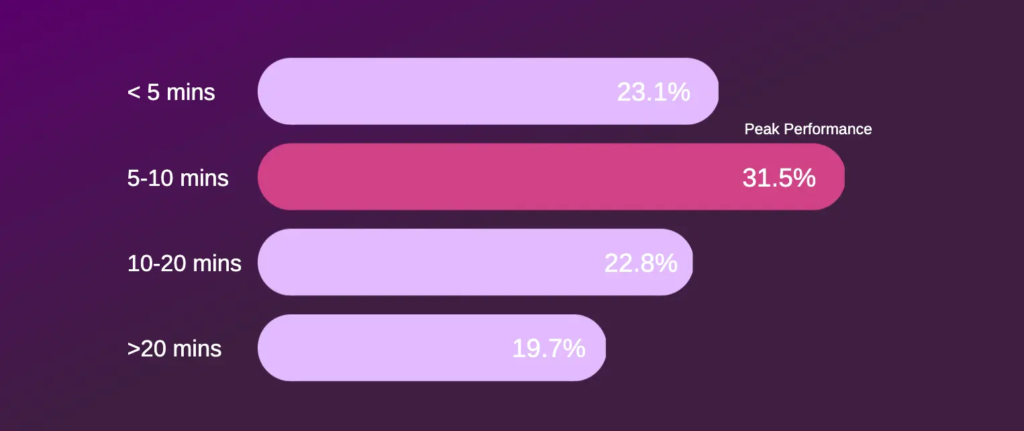
Video essays generally have lower retention rates because they tend to go over 20 minutes. That’s mostly because of those pesky short attention spans we’re all dealing with today, but let’s look at the numbers.
A 5-10 minute video has around 30% retention beyond the hook. While a 20+ minute one only has 19.7%
So why does this happen and how can we stop it?
1. The BIG promise.
Every video has a payoff. The reason why your viewers keep watching. For video essays that tends to be an answer to a critical question. Let’s look at what some stellar channels in this niche are doing.
This video by Philosophy Tube (love this channel!) talks about declining birthrates. It immediately makes the audience ask why are birth rates dropping and why are we all getting it wrong?
This sets up the audience to stick around until they get the answer to the question posed at the beginning. That answer is the big payoff, which is why you can’t give it away too early.
2. Remind the audience of why they’re sticking around.
Remember those pesky short attention spans? They’re unfortunately working against you, so you have to remind the audience of why they are watching your video so they stick around until it’s time for the big payoff.
That doesn’t mean you have to say “hey viewer, stick around a bit you’ll get the answer soon I promise”. Instead, continue to hook your audience through value.
Let’s go back to the Philosophy Tube video on declining birthrates. Abigail (who is a fantastic writer) offers us mini-payoffs throughout the video. The road from A to B isn’t linear, if it were, the video would be over very quickly.
So what do we do? We engage our audience to think deeply about your content with mini-hooks and transitions that develop our argument.

Here’s a snippet from around the middle of Abigail’s script:
We have Chris Haines saying the decline in birth rate is due to, ‘demonising the traditional family,’ an entirely imaginary phenomenon. And Abby Schult saying the answer is to curtail women’s reproductive rights. We also have a lot of people falsely saying the Earth is overpopulated. The fear of overpopulation is actually a hangover from a previous moral panic.
Let’s break that down.
Abigail harkens back to the main argument:
- We have Chris Haines saying the decline in birth rate is due to, “demonising the traditional family,” an entirely imaginary phenomenon. And Abby Schult saying the answer is to curtail women’s reproductive rights.
Then she offers a new angle that builds on from the last:
- We also have a lot of people falsely saying the Earth is overpopulated.
And a hook that expands the argument and transitions into the next one:
- The fear of overpopulation is actually a hangover from a previous moral panic.
This “but wait, there’s more” moment is key to maintaining steady retention throughout your video essay, but you have to be clever about how you do it.

3. Information density.
By nature, video essays are information packed. They are essays after all, but that doesn’t mean they’re just visual academic papers.
YouTube is a medium where you are talking directly to people, so your content has to be understandable and digestible. That doesn’t mean it can’t be complicated or nuanced. The opposite in fact.
But if you have a video that is really information dense, with little to no analysis, then you aren’t engaging the audience. Why exactly? Because you’re telling them information instead of asking them to mentally interact with it.
Never underestimate your audience.
I really recommend watching videos that deal with information dense topics (Vox is particularly good at this) and break down how they introduce, explain and then analyse data and sources.
4. Control What You Can
The truth is, even doing all of this the algorithm might still punish your video for any number of reasons, but by engineering your script with retention in mind, particularly in this niche, you can take back some of that control.
Tackling a video essay is a mammoth project. If you’re struggling to get started, or things are getting unsustainable, get in touch. I’m always happy to answer any questions.